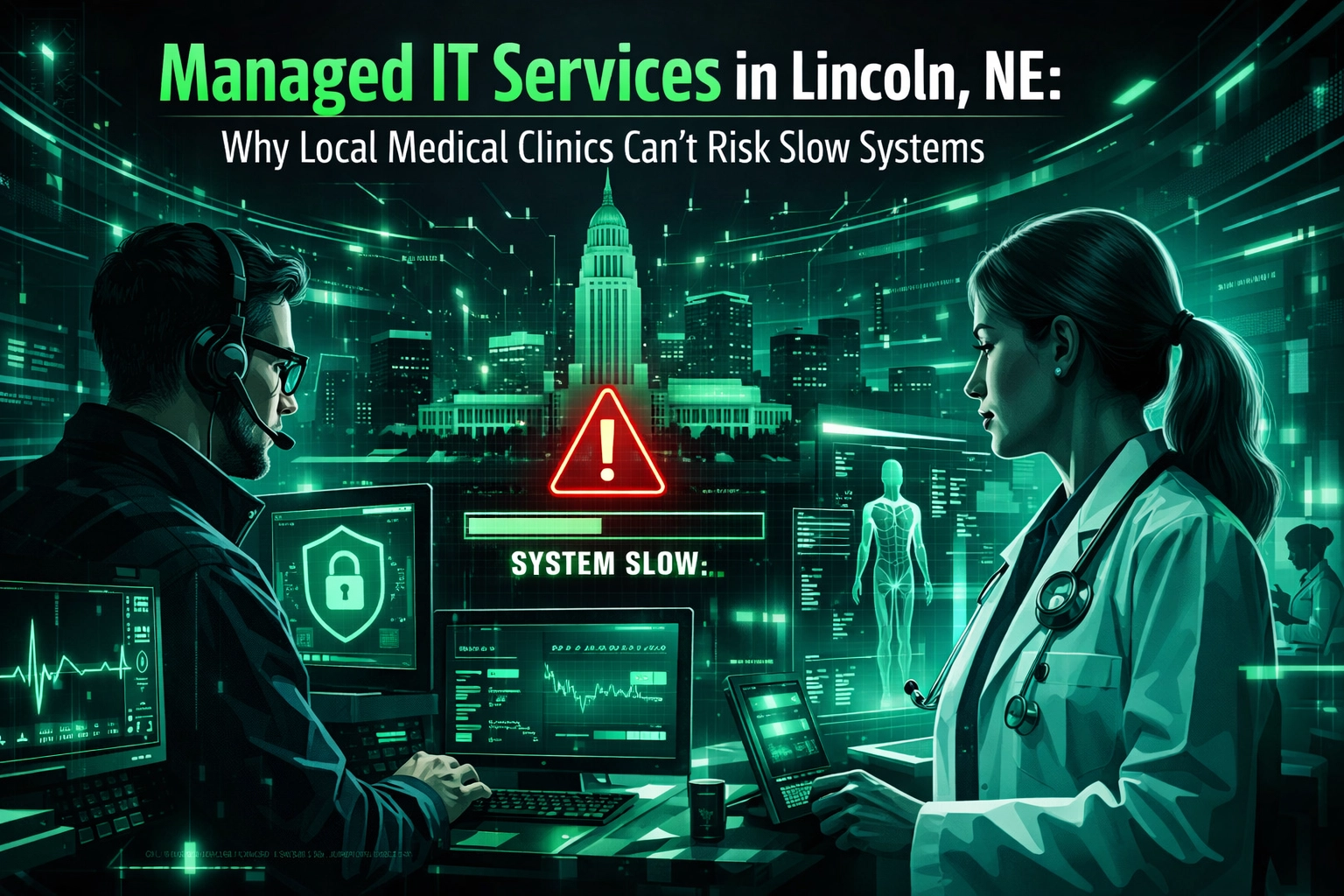
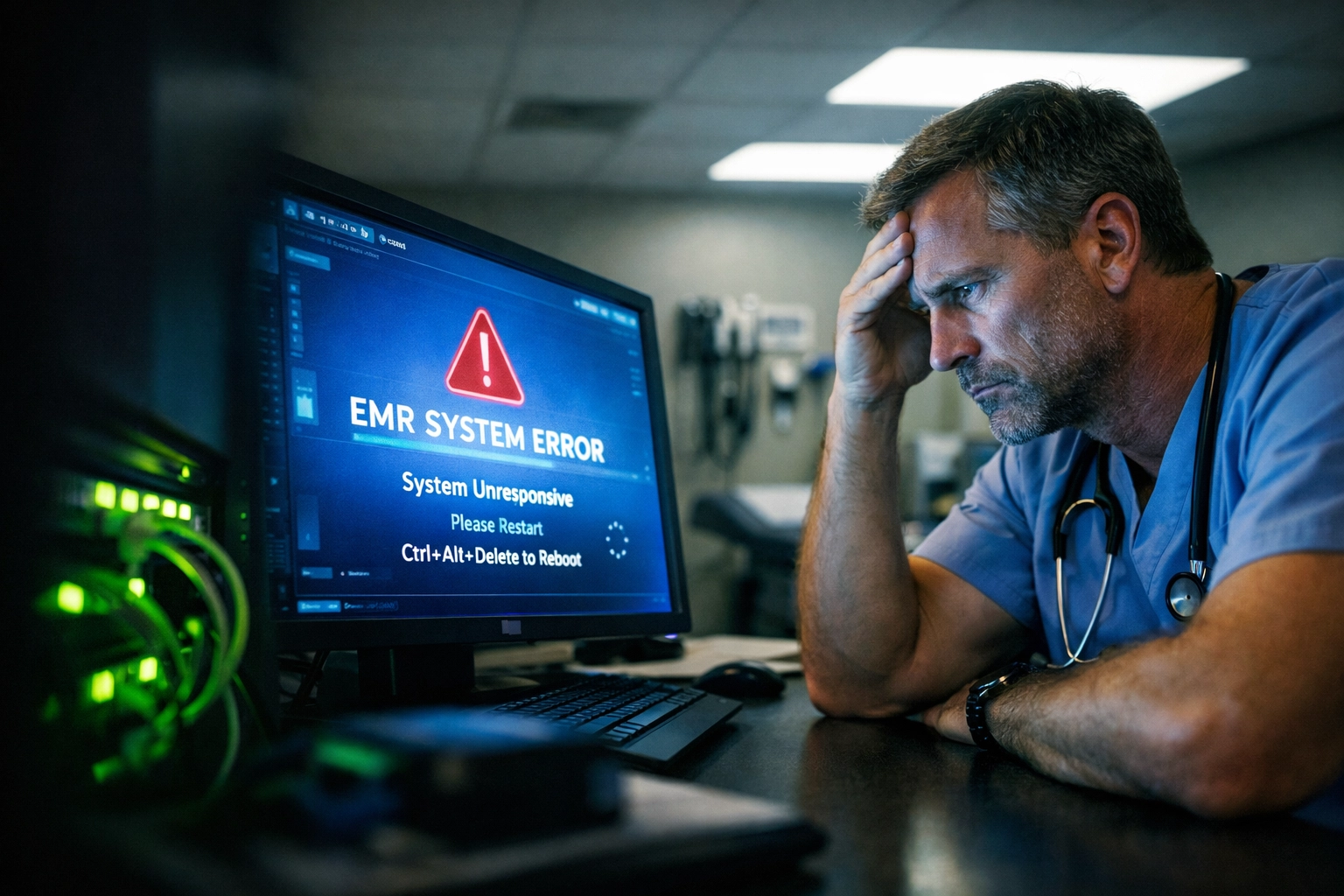
When your EMR freezes during patient check-in, you're not just dealing with an IT problem. You're dealing with backed-up waiting rooms, frustrated staff, delayed treatments, and potential compliance violations. For medical clinics in Lincoln, slow or unreliable IT systems aren't a minor inconvenience: they're a critical business risk that affects patient safety, billing accuracy, and your ability to stay compliant with HIPAA.
Most healthcare providers don't realize how vulnerable they are until something breaks. By then, it's too late.
Why Medical Clinics Can't Afford Downtime
Patient care stops when systems go down. Your Electronic Health Record (EHR) system isn't optional infrastructure: it's the operational backbone of your clinic. When it slows down or fails, clinicians can't access patient histories, order medications, or document treatment decisions. That's not just frustrating. It's dangerous.
Multi-location practices managing complex infrastructure: dozens of devices, cloud-based EMR systems, servers, and network dependencies: face even higher stakes. One system failure can cascade across your entire operation. We've seen Lincoln-area practices experience 35-40% improvements in uptime after switching to proactive IT support that actually monitors and maintains systems before they fail.
Compliance isn't negotiable. HIPAA requires specific security controls around Protected Health Information (PHI). Slow systems force your staff into workarounds that bypass those controls. When your network crawls, nobody wants to deal with multi-factor authentication. When endpoints lag, security patches get delayed. Those gaps create vulnerabilities that put you at risk for breaches, fines, and reputation damage.
Slow performance isn't just a productivity problem. It's a compliance problem.
Downtime costs real money. When your systems are unavailable, you can't:
- Bill patients accurately
- Process insurance claims
- Schedule appointments
- Document care properly
- Maintain operational workflow
Every hour of downtime translates directly into lost revenue and staff overtime spent catching up once systems come back online. For a clinic running on tight margins, that adds up fast.
What's Actually Slowing Down Your Systems
Most medical clinics in Lincoln are dealing with the same foundational issues:
Legacy Infrastructure That Wasn't Built for Modern Demands
Your EHR system was probably implemented years ago when patient volumes were lower and regulatory requirements were simpler. Now you're running cloud-based applications, telehealth platforms, digital imaging, and electronic billing: all on infrastructure that was never designed to handle that load.
Bandwidth limitations. If your network can't support simultaneous users accessing patient records, uploading imaging files, and processing insurance claims, everything slows down. It's not always about speed: it's about capacity under real-world operational conditions.
Outdated hardware. Servers and workstations have lifespans. After 4-5 years, they start failing more frequently and running slower. When you're piecing together aging equipment because "it still works," you're trading upfront replacement costs for constant performance issues and eventual catastrophic failure.
Reactive IT Support That Responds After Problems Occur
Most clinics rely on break-fix IT support: someone who shows up when something breaks. That model doesn't work for medical environments where downtime isn't acceptable.
No proactive monitoring. If your IT provider isn't actively watching system performance, catching failing hard drives before they crash, and identifying bottlenecks before they slow patient care, you're always reacting to problems instead of preventing them.
Slow response times. When systems go down, waiting hours (or days) for a technician isn't acceptable. Medical clinics need support that responds in minutes, not ticket queues that stretch into next week.

Security Gaps That Put Patient Data at Risk
Healthcare is one of the most targeted industries for cyberattacks. Ransomware, phishing attempts, and data breaches aren't hypotheticals: they're daily threats that require active defense.
Inadequate endpoint protection. Every workstation, laptop, and tablet accessing patient data needs Endpoint Detection and Response (EDR) tools that go beyond basic antivirus. If your devices aren't actively monitored for threats, you're vulnerable.
Weak access controls. Who has access to what patient data? Are former employees still in your system? Can anyone plug a USB drive into a workstation and walk out with PHI? These aren't edge cases: they're common vulnerabilities we see in Lincoln clinics every week.
No phishing training. Your staff is the first line of defense against cyberattacks. If they're not trained to recognize phishing attempts, credential theft, and social engineering tactics, one clicked link can compromise your entire network.
What Managed IT Services Actually Do for Medical Clinics
Managed IT isn't just outsourced help desk support. It's a complete operational shift from reactive troubleshooting to proactive system management.
24/7 Monitoring and Maintenance
We monitor your systems around the clock: not just during business hours. That means:
- Automated alerts when servers show signs of failure
- Performance tracking to identify slowdowns before they impact patient care
- Patch management that keeps systems secure and compliant without disrupting operations
- Backup verification to ensure patient data can actually be recovered if something fails
Proactive monitoring reduces downtime by catching problems before they become emergencies. For Lincoln clinics, that translates to fewer interruptions, faster operations, and staff who can focus on patient care instead of fighting with technology.
HIPAA-Aligned Security Operations
HIPAA compliance isn't a checklist. It's an ongoing operational discipline that requires:
- Regular risk assessments to identify vulnerabilities
- Encryption for data at rest and in transit
- Access controls that limit who can view, edit, or export patient data
- Audit trails that document every system interaction for compliance reporting
- Incident response plans that define exactly what happens if a breach occurs
We build security infrastructure that meets HIPAA requirements without making your systems harder to use. That means Multi-Factor Authentication (MFA) that's fast, EDR that runs quietly in the background, and firewall configurations that protect your network without blocking legitimate traffic.

Fast Local Response When Issues Occur
Even with proactive monitoring, things occasionally break. When that happens, you need someone local who can respond immediately: not a national helpdesk that routes you through three levels of support before dispatching a technician from another state.
15-minute response times. When your EMR goes down, we're responding within minutes: not hours. For Lincoln-area clinics, that means faster resolution and less operational disruption.
Onsite support when needed. Some problems can't be fixed remotely. Hardware failures, network cabling issues, and equipment replacements require someone who can show up at your clinic, assess the situation, and fix it without waiting for parts to ship or external vendors to coordinate.
How to Choose IT Support That Actually Works for Healthcare
Not all Managed IT providers understand healthcare operations. Here's what to look for:
Healthcare-specific experience. Does the provider work with other medical clinics? Do they understand EHR systems, HIPAA requirements, and the regulatory environment you operate in? Generic IT support doesn't translate well to healthcare: you need someone who knows the industry.
Transparent pricing. Flat-rate monthly billing should cover monitoring, maintenance, security, and support: not just basic helpdesk access. Hidden fees, per-ticket charges, and surprise invoices are red flags.
Proactive methodology. Ask how they prevent problems, not just how they fix them. If the answer focuses on response times instead of monitoring, maintenance schedules, and system health tracking, keep looking.
Local presence. For Lincoln and Omaha clinics, having a provider who can respond onsite matters. Remote-only support works for some issues, but hardware failures and infrastructure problems require physical presence.
Security foundations. HIPAA compliance requires specific technical controls. Does the provider implement EDR, MFA, encryption, and regular security assessments as standard practice: or are those optional add-ons?
Stop Tolerating Slow Systems
Medical clinics in Lincoln can't afford to operate on unreliable IT infrastructure. When your systems slow down, patient care suffers, compliance risks increase, and revenue gets delayed. Proactive IT support fixes those problems before they disrupt operations.
We don't do break-fix support. We manage, monitor, and maintain systems so they don't break in the first place. That means:
- Faster EHR performance through optimized infrastructure
- HIPAA-aligned security that protects patient data
- Local support that responds when you need it
- Transparent pricing with no surprises
If your business in Lincoln or Omaha is dealing with slow systems, downtime, or unreliable IT support: SAINT fixes it before it becomes a problem.
Call 531-625-2111 or visit saintsecured.com to schedule a no-pressure IT infrastructure assessment. We'll show you exactly where your systems are vulnerable and how to fix them.